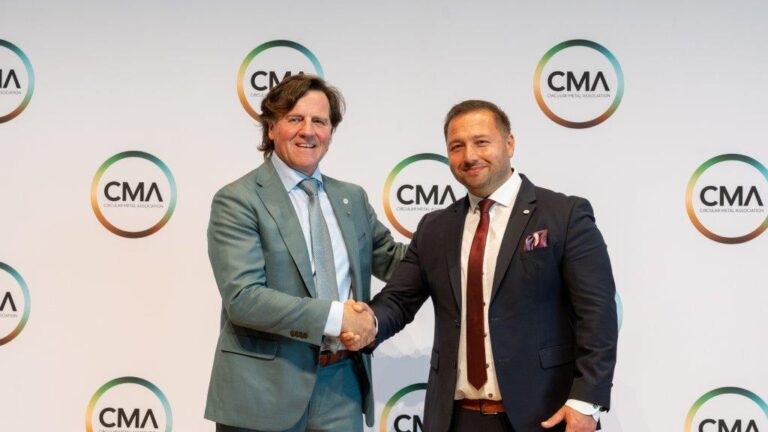
At the BGA Entrepreneurs’ Day in Berlin, CMA President Murat Bayram warned against trade barriers for recycled raw materials. From the association’s perspective, security of supply requires an efficient recycling industry, a competitive industry, and functioning international markets.
Berlin, Düsseldorf, Brussels, 17/09/2026 – The Circular Metal Association (CMA) warns against interference in the international trade of recycled raw materials. The occasion was the Entrepreneurs’ Day of the Federal Association of Wholesale, Foreign Trade and Services (BGA), which was held in Berlin under the motto “Systemically Relevant”. In the entrepreneur Q&A, CMA President Murat Bayram answered the moderator’s questions.
Previously, Federal Chancellor Friedrich Merz had advocated for securing Europe’s resilience through partnerships and not through isolation. Bayram followed up on this. “Europe’s raw material security does not arise from isolation,” he said. “It arises from a strong recycling industry, a competitive industry, and functioning international markets.”
Since March 2025, the EU Commission has been examining export restrictions for metal scrap and monitoring trade flows. In October 2025, it refrained from doing so for steel scrap, and for aluminium scrap, it dropped a planned export duty.
The actual restriction is already in waste law anyway: from 21 May 2027, the Waste Shipment Regulation prohibits the export of metal scrap to non-OECD countries. Exempt are countries that are on a list from the EU Commission. This list is due by 21 November 2026 – in just over two months.
Local Collection, International Markets
Especially with steel and metals, it becomes clear how closely the circular economy and global trade are linked. Recycled raw materials are collected locally and processed regionally, but traded internationally. Anyone who wants to keep them in Europe via export restrictions is therefore not interfering in a marginal area, but in the business model of an entire industry, Bayram warned.
This would hit a sector largely characterised by small and medium-sized enterprises, typical for Germany as an industrial location. The companies that collect, sort, and process metals are predominantly family-run, many in their second or third generation. These businesses provide the investments in sorting and processing technology on which Europe’s supply of recycled raw materials is based.
Furthermore, from the CMA’s perspective, the focus on export restrictions is too narrow. Anyone wishing to strengthen Europe’s recycling industry must also strengthen its markets – and ensure that a competitive European industry creates demand for raw materials here.
“An export restriction can keep raw materials in Europe. It cannot mandate the demand for them,” said Bayram. A demand for Brussels: “Europe should close loops, not markets – and strengthen the industry that uses recycled metals.”
__________________________
About the Circular Metal Association (CMA)
The Circular Metal Association is Europe’s leading industry association for steel and metal recycling. Nearly 900 member companies cover the entire spectrum: from collection and processing to trading and supplying the metal and steel processing industries. Around 90 per cent of the industry companies active in the market are organised within the CMA. Its members supply the recycled raw materials with which European industry works – and are thus an indispensable part of the European raw material industry. The CMA was formed from the merger of the German Steel Recycling and Waste Management Association (BDSV) and the Association of German Metal Traders (VDM).
We create certainty.