CMA welcomes the EU Commission’s decision to refrain from the trade measures initially announced for recycled aluminium. At the same time, it warns against subsequently introducing comparable restrictions via waste law.
Berlin, Düsseldorf, Brussels 14.09.2026 – The Circular Metal Association (CMA) welcomes the European Commission’s decision not to present the trade measures for the export of recycled aluminium announced for 23 September. The cabinet of Executive Vice-President Stéphane Séjourné communicated the withdrawal on 4 September. Instruments such as export duties, which would have restricted exports to a limited extent, had been under discussion.
The Commission justifies this by referring to internal consultations: the proposed instrument would only have covered about half of the export volumes. Instead of a trade instrument, the Commission is now working on a solution within waste law.
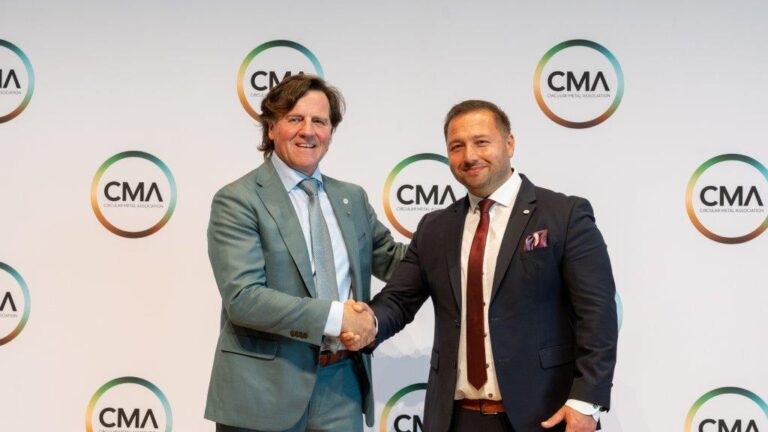
CMA considers it the right step that the Commission is fundamentally reviewing the trade measures originally planned. “Particularly with such a far-reaching intervention in functioning raw material markets, it is right to first carefully consider all impacts and alternatives,” says CMA President Murat Bayram. “An intervention of this magnitude would have been disproportionate and would have had significant negative consequences for the entire aluminium value chain.”
For CMA, this decision is also a signal that the Commission is taking the concerns of the recycling industry seriously. From the association’s perspective, functioning global raw material markets are the best basis for a competitive European economy – this applies particularly to the recycling sector. “We welcome the fact that the Directorate-General for Internal Market shares this insight and recognises the interdependencies of the value chain,” says Bayram.
Debate shifts to the Waste Shipment Regulation
The trade instrument is to be replaced by a delegated act within the framework of the Waste Shipment Regulation. It is intended to exclude the export of certain waste – including recycled aluminium – to non-OECD countries. This would affect key target markets outside Europe: China, India, and Southeast Asian states do not belong to the OECD. An exception is planned for some EU candidate countries.
This path is not new: the stricter export rules of the Waste Shipment Regulation have already been adopted and will apply from 21 May 2027. Non-hazardous waste may then only be exported for recovery to those non-OECD countries that have proven environmentally sound management to the Commission and are on its list.
However, the text of the planned delegated act is not yet available. It remains open which types and qualities of waste will be covered and which candidate countries are exempt. The Commission has announced a public consultation and aims for adoption by the end of 2026.
Environmental law must not become a trade policy lever
The CMA views with concern the fact that the Commission is now pursuing its goal via waste law. The Waste Shipment Regulation governs which non-OECD countries European waste may still be exported to in the future. Whether a country is included in the list of approved states must depend solely on whether it treats waste according to standards equivalent to European ones. Using an environmental law instrument to limit exports for trade policy reasons would be a misuse of its intended purpose. The CMA will resolutely oppose this.
The question will gain practical significance in just a few weeks. The publication of the list of authorised non-OECD states is planned for 21 November 2026. Important customer countries with state-of-the-art plants are indispensable as an outlet for unused recycled metals in the EU and must be included in the list. A de facto export ban on recycled aluminium would interrupt global cycles and weaken Europe’s overall competitiveness.
Evaluate first, then regulate
Before further export restrictions are introduced, their impact on the entire value chain must be carefully evaluated. The decisive question here is whether there is even sufficient industrial demand and processing capacity in Europe for the recycled raw materials concerned. Closing markets does not yet create demand.
CMA will participate in the announced consultation. At the same time, the association appeals to the Commission to involve the recycling industry more closely in the development of future solutions. “Our industry has concrete proposals on how we can use more recycled metals in Europe, strengthen investment and industrial demand, and simultaneously reduce bureaucracy – without creating new trade barriers,” says Bayram.
Metals must flow to where they are needed
“We should not conduct this debate as a conflict between the recycling industry and the manufacturing industry. On the contrary: we need each other. Our common goal must be a strong, competitive European industry that uses as many recycled metals as possible here in Europe,” emphasises Bayram.
However, a circular economy only works if both sides of the cycle function – those who recycle, recover, and trade raw materials, and those who use them again. If production and demand in Europe decline, recycled metal cannot simply be held in the internal market in the expectation that this will create new demand. “Metals must be able to flow to where they are actually needed and processed,” says the CMA President.
Therefore, CMA wants to build bridges – between producers and recyclers, between industrial and environmental policy, and between Europe’s legitimate interests and functioning international raw material markets. The association expressly shares the Commission’s goal of strengthening Europe’s industrial base and its raw material supply.
“But we are convinced that there are smarter ways than additional trade barriers: less bureaucracy, better investment conditions, competitive energy prices, and stronger incentives for the use of recycled raw materials in Europe,” says Bayram.
__________________________
About the Circular Metal Association (CMA)
The Circular Metal Association is Europe’s leading industry association for steel and metal recycling. Nearly 900 member companies cover the entire spectrum: from collection and processing to trading and supplying the metal and steel processing industries. Around 90 per cent of the industry companies active in the market are organised within the CMA. Its members supply the recycled raw materials with which European industry works – and are thus an indispensable part of the European raw material industry. The CMA was formed from the merger of the German Steel Recycling and Waste Management Association (BDSV) and the Association of German Metal Traders (VDM).
We create certainty.