The CMA criticises the EU Commission’s draft list of approved non-OECD recipient countries. According to the association’s assessment, the proposed treatment of recycled metals would largely exclude important Asian sales markets.
Berlin, Düsseldorf, Brussels, 21.09.2026 – The Circular Metal Association (CMA) is sharply criticising a draft by the European Commission, with which the authority intends to specify the export rules of the amended Waste Shipment Regulation for recycled metals. The draft for a delegated act, published by the Commission last Friday, contains a list of non-OECD countries that will be permitted to import recycled steel and recycled non-ferrous metals from the EU in future. It includes only a few EU candidate countries. All other non-OECD countries would be cut off from deliveries as of 21 May 2027, including all major Asian sales markets.
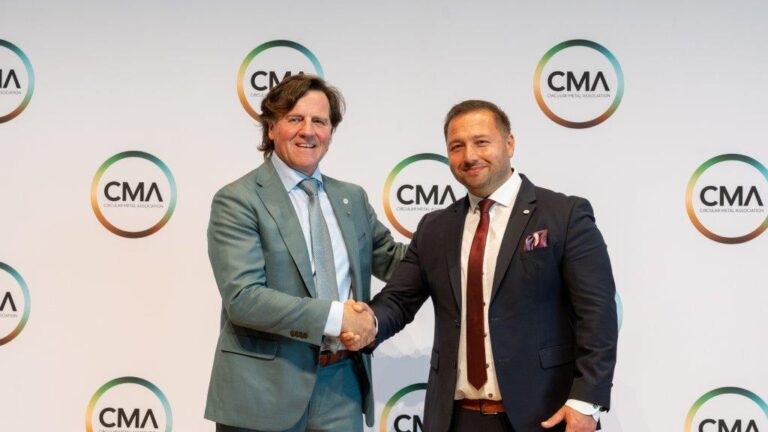
“The Commission is applying a special standard to recycled metals that is not provided for in the Waste Shipment Regulation. The result is an export ban for the most important sales markets. We will fight this with all means,” says CMA President Murat Bayram.
Non-discriminatory case-by-case review instead of blanket suspicion
The background to this is a provision in the amended Waste Shipment Regulation. According to this, non-hazardous waste for recovery may only be exported to non-OECD countries that have demonstrated environmentally sound treatment to the Commission and are therefore on the list. However, in its draft, the Commission is applying a significantly stricter standard to recycled metals than to other types of waste.
The Commission justifies its proposal by stating that recycled metals could contain toxic heavy metals and are not biodegradable. This would create environmental risks during shredding, smelting, and refining. Unlike, for example, paper, the Commission assumes a higher risk for metals from the outset.
“Here, a single group of materials is prejudged across the board, and without any factual basis,” says Bayram. “Recycled metals are thus discriminated against compared to all other types of waste. Yet it is possible to check how cleanly a country processes them. One just has to do it.”
The CMA therefore calls on the Commission to abandon the special standard for metals and to apply the procedure provided for in the Regulation. According to this, an assessment of the treatment standards in the respective recipient country determines whether exports are permitted there.
Waste law is not a trade instrument
The CMA doubts that the Commission is actually concerned about environmental protection. In addition to the rules of the Waste Shipment Regulation, the authority had planned its own trade policy measure against the export of recycled aluminium. At the beginning of September, it withdrew this proposal and instead announced the delegated act now presented. “Export restrictions for recycled metals are the wrong way to go. Introducing them via waste law does not make it any better,” Bayram clarifies.
Europe’s recycling companies already supply the majority of the metals they produce to manufacturers in the EU. Only around 20 per cent are exported. However, these exports are indispensable for selling volumes that the European market cannot absorb.
An export ban that keeps these quantities within the internal market does not strengthen Europe’s industry – it weakens the economic foundation of the European circular economy. “Closing international markets does not create additional demand or greater competitiveness in Europe,” explains Bayram. “If European metal producers do not take up the available quantities, sales markets disappear, material values come under pressure, and surpluses grow. This hits precisely those who make Europe’s circular economy possible every day: the companies that collect, sort, process, and bring recycled raw materials back into the economic cycle.”
For Bayram, it is therefore clear: “The circular economy is not created by walls around Europe, but by functioning markets. Anyone who holds recycled raw materials in Europe without simultaneously creating demand does not strengthen the cycle – they interrupt it. Europe does not become more competitive by closing markets. Europe must become so competitive that it does not need closed markets.”
Raw material security needs open markets
The CMA and the Commission are certainly in agreement on the goal. The association also wants to strengthen Europe’s industrial base and its raw material supply. “However, we are convinced that there are smarter ways than additional trade barriers – less bureaucracy, better investment conditions, competitive energy prices, and stronger incentives for the use of recycled raw materials in Europe,” says Bayram. “A de facto export ban for recycled metals interrupts global cycles and weakens Europe’s overall competitiveness. Ultimately, no one benefits from trade restrictions.”
The CMA will participate intensively in the ongoing consultation, which ends on 16 October, and will push for a revision of the draft. At the same time, the association appeals to the Council and the European Parliament to raise objections to the legal act.
____________________________________
About the Circular Metal Association (CMA):
The Circular Metal Association is Europe’s leading trade association for steel and metal recycling. Nearly 900 member companies cover the entire spectrum: from collection and processing to trade and supply to the metal and steel processing industry. Around 90 per cent of the companies active in the market are organised within the CMA. Its members supply the recycled raw materials with which European industry works – and are thus an indispensable part of the European raw materials industry. The CMA was formed from the merger of the Federal Association of German Steel Recycling and Waste Management Companies (BDSV) and the Association of German Metal Traders (VDM).
We create certainty.