- Appeal from the CMA Summit: Recycling companies need planning and legal certainty to provide European industry with a reliable supply of raw materials
- Ahead of the decision on the country list for the Waste Shipment Regulation, the CMA welcomes the indicated expansion and reiterates its call to abolish the special benchmark for metals
- Four areas of action – from a raw materials strategy and open markets to resilient recycling infrastructure
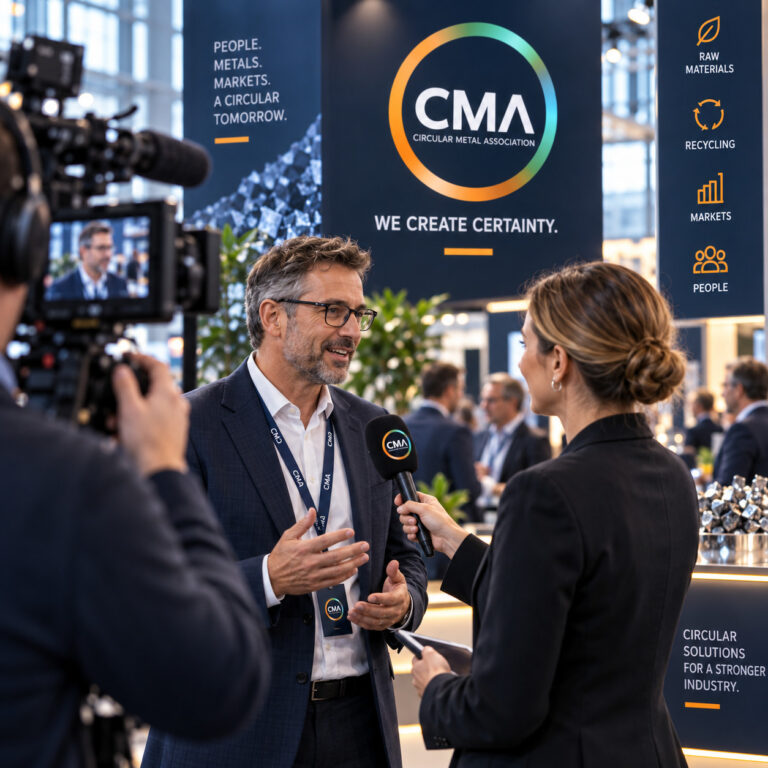
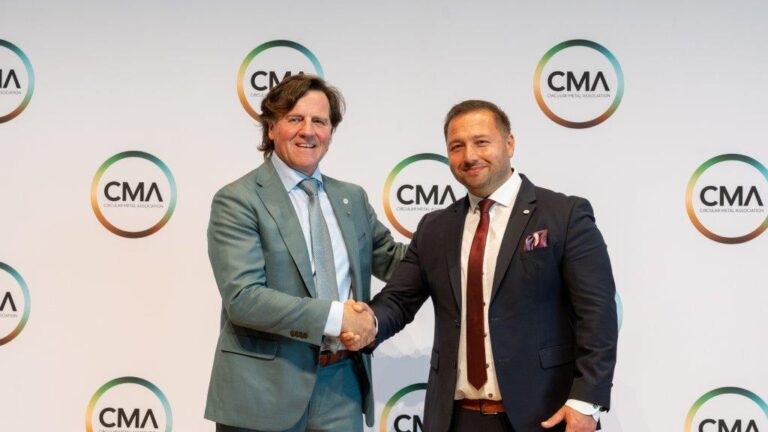
Berlin, Düsseldorf, Brussels, 23/11/2026 – The Circular Metal Association (CMA) has called on policymakers to establish a solid foundation for Europe’s raw materials supply. ‘Steel mills, smelters and foundries work day in, day out with recycled raw materials supplied by our companies – in large volumes and specified qualities. However, we can only offer this reliability if we can rely on policymakers just as our customers rely on us,’ said CMA President Murat Bayram on 19 November at the CMA Summit in Berlin. ‘At present, our companies all too frequently experience the opposite – looming export restrictions, special rules applied solely to metals, precarious logistics, and risks with which they are left to deal alone,’ Bayram told around 650 participants.
Just how tangible the impending export restrictions are is illustrated by the country list under the Waste Shipment Regulation. It determines to which non-OECD countries recycled steel and recycled non-ferrous metals can still be exported as of 21 May 2027. The draft from September permits only a few EU candidate countries for metals – which, in the view of the CMA, equates to a de facto export ban. The European Commission was originally scheduled to adopt the list by 21 November. The final version is now expected to follow within the next two to three weeks.
Early indications suggest that it may differ from the draft. According to information from the European umbrella association Recycling Europe, the Commission intends to expand the list, although it remains undecided which countries will be added. Furthermore, it is prepared to review the list whenever improvements are identified in third countries – at least every two years, and more frequently if necessary. The CMA regards this as an encouraging sign, but will continue to press Brussels to scrap the special benchmark for recycled metals and lift all export restrictions.
Four demands for policymakers
The country list is the most pressing issue in terms of timing, but it is not the only factor that will decide the future of Europe’s raw materials supply. From the CMA’s perspective, security of supply also depends on competitive industrial conditions, safe recycling facilities, and efficient logistics. In all these areas, the supply of raw materials to industry can only ever be as reliable as the framework conditions under which recycling companies operate. The CMA therefore derives four key demands for the German Federal Government and the EU.
- Recognising recycled raw materials as part of the raw materials strategy
Recycled metals are raw materials of strategic importance, not residual matter relegated to waste legislation. The CMA demands that the recycling industry be integrated wherever decisions regarding security of supply are made. Its member companies have precise knowledge of actual material flows and sales markets – insights that enable more effective and accurate political decision-making.
- Open markets instead of protectionism
Raw material security is not achieved through protectionism, but through a robust recycling industry, a competitive manufacturing sector, and functioning international markets. The CMA therefore opposes the special benchmark applied to metals in the country list – particularly as the Waste Shipment Regulation prescribes the same assessment procedure for all non-hazardous waste. Should the Commission nevertheless maintain this stance, the CMA calls on the Council of the EU and the European Parliament to raise objections.
A study conducted by Fraunhofer IKTS on behalf of the CMA, using copper as an example, demonstrates that export restrictions weaken rather than secure the supply to industry. When sales channels are eliminated, prices fall, meaning that the collection of complex materials in particular is often no longer viable. Ultimately, industry would end up with fewer secondary raw materials rather than more – and whatever is not recycled must be mined.
- Strengthening industry and the recycling sector together
Europe does not suffer from a lack of recycled raw materials, but from a lack of conditions that allow them to be processed competitively here. The automotive and mechanical engineering sectors, two of the most vital end-markets for recycled metals, are facing substantial pressure. The CMA therefore calls for competitive energy prices, faster permitting procedures, less red tape, and targeted incentives for using recycled metals. An export restriction may keep raw materials in Europe, but it cannot decree industrial demand for them.
Policymakers must also support the recycling industry itself. The sector is characterised by small and medium-sized enterprises; many are family-owned, often in their second or third generation. They finance their investments in shredders, sensor technology, and sorting facilities – which underpin the quality of recycled raw materials – from their own revenues. If material values drop, for example due to the loss of sales markets in non-OECD countries, the capital required is no longer available. What is not invested today will lead to a shortfall in material quality tomorrow.
- Making recycling structures safe and predictable
A dependable supply requires safe facilities and dependable logistics. Fire incidents in the waste management and recycling plants surveyed have almost tripled within five years. Where the cause can be identified, incorrectly disposed lithium-ion batteries are by far the most frequent trigger. While companies have invested significantly in early fire detection and extinguishing technology, they cannot eliminate fires altogether. In nearly half of the facilities surveyed, the majority of fires in 2025 broke out even before the actual processing stage, such as in intake areas, storage facilities, and bunkers. Insurers are already beginning to withdraw from the sector in some instances.
Yet recyclers decide neither which products enter the market, nor how they are designed or how their return is organised. Together with other waste management associations, the CMA is therefore calling for manufacturers to contribute to consequential costs via a prevention and compensation fund. Those who want to close loops must also protect the operators closing them.
Predictability is also lacking in rail freight. According to a CMA survey of 79 member companies, 82 per cent of respondents were unable to fulfil delivery contracts, or could only partially fulfil them, in the first half of 2026 due to unavailable or unpunctual wagons. 71 per cent cited replacement road haulage by lorry as the consequence – even as the German Federal Government aims to raise rail’s share of freight transport to at least 25 per cent by 2030. The CMA demands that the reliability of single wagonload traffic be made a measurable prerequisite for state funding.
Black paper ‘Permits Rethought’ handed over
The vital importance of reliable frameworks was also evident at the Summit during the discussion on permitting. The CMA presented the results of its ‘Permits Rethought’ black paper initiative to Mario Suckert, State Secretary in the Thuringian Ministry for Economic Affairs, Agriculture and Rural Areas. In the ensuing discussion, Suckert and CMA Managing Director Guido Lipinski explored ways to accelerate permitting processes. Both agreed that businesses willing to invest and advance innovation require planning certainty above all else. Permitting procedures must therefore become more efficient and must not unnecessarily obstruct entrepreneurial endeavours.
‘Close loops, not markets’
The Summit, the CMA’s first annual conference following the completed merger of BDSV and VDM, also served as a gathering of international partners. Among the guests was Robin K. Wiener, President of the Recycled Materials Association (ReMA) based in Washington, D.C. Julia Ettinger, Secretary General of Recycling Europe, was also in attendance and took part in the panel. The CMA maintains close, cooperative relationships with both organisations.
The CMA also reaches out to policymakers for dialogue. Anyone seeking to establish reliable conditions for the supply of raw materials will find the association an informed partner representing around 90 per cent of the companies active in this market – from collectors and processors to traders.
‘Recyclers need a strong industry – but a strong industry equally needs strong recyclers,’ said Bayram. ‘Neither end of this chain must be weakened. Europe should close loops, not markets. If policymakers provide reliable conditions for this, we will ensure that raw materials reach the places where they are needed.’
__________________________
About the Circular Metal Association (CMA)
The Circular Metal Association is Europe’s leading industry association for steel and metal recycling. Nearly 900 member companies cover the entire spectrum: from collection and processing to trading and supplying the metal and steel processing industries. Around 90 per cent of the industry companies active in the market are organised within the CMA. Its members supply the recycled raw materials that European industry relies upon – making them an indispensable component of the European raw materials sector. The CMA was formed from the merger of the Federal Association of German Steel Recycling and Waste Management Companies (BDSV) and the Association of German Metal Traders and Recyclers (VDM).
We create certainty.